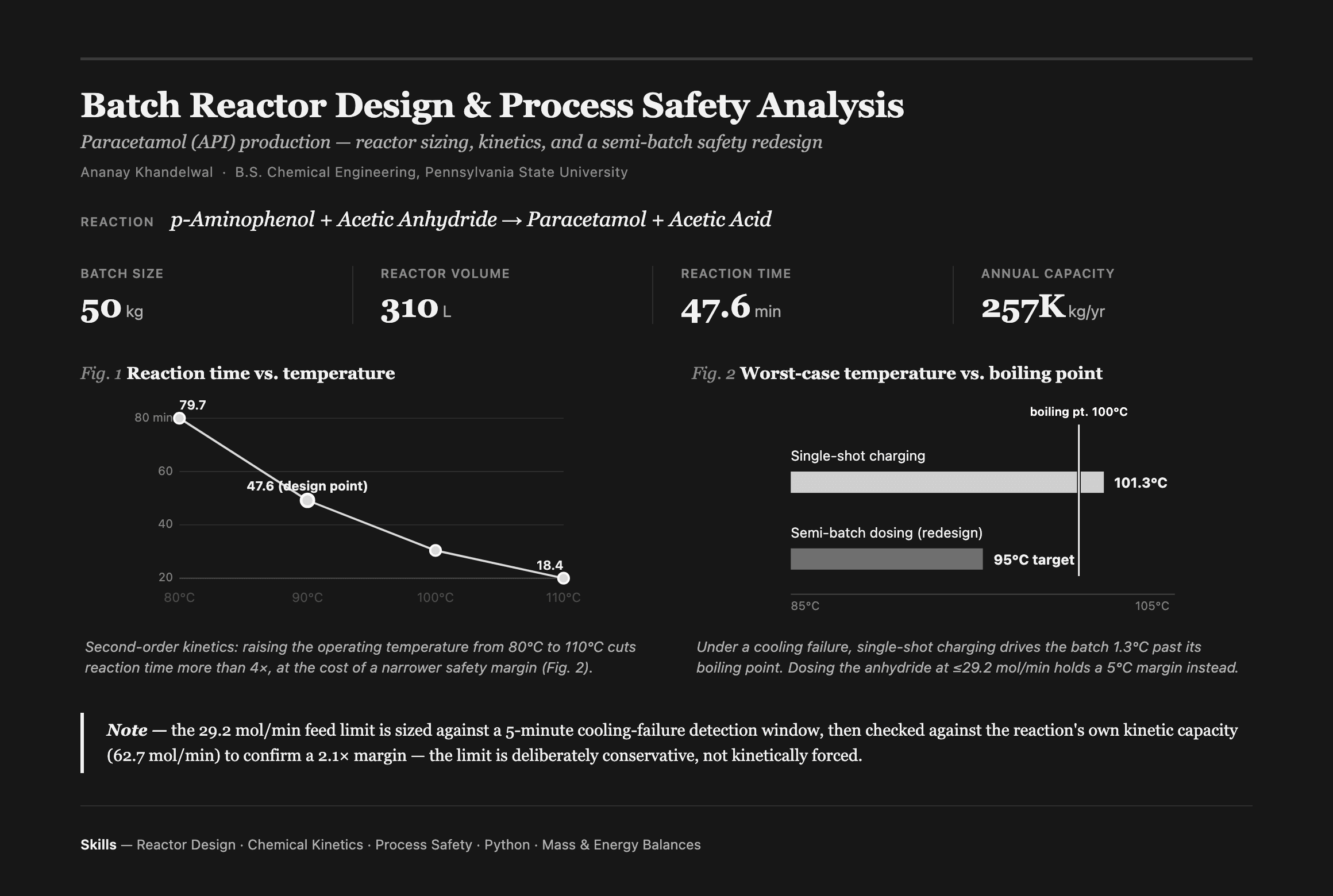
Paracetamol is made by acetylating p-aminophenol with acetic anhydride, an irreversible, exothermic, second-order reaction studied in the literature across 80–110°C.
Sized a 310 L vessel at 75% fill for a 50 kg/batch target at 95% conversion; kinetics at the 90°C design point give a 47.6-minute reaction time and a 92.6-minute full cycle, supporting roughly 257,000 kg/yr.
Ran a cooling-failure safety analysis using MTSR (Maximum Temperature of the Synthesis Reaction): a single-shot charge produces an 11.3°C adiabatic rise, pushing MTSR to 101.3°C, 1.3°C past the assumed 100°C boiling point.
Redesigned the charging strategy to semi-batch dosing: capped the maximum unreacted inventory at 146 mol (a 5°C MTSR margin) and converted that to a 29.2 mol/min dosing limit using a 5-minute failure-detection window, comfortably inside the existing cycle time and 2.1x below the reaction's own kinetic capacity.
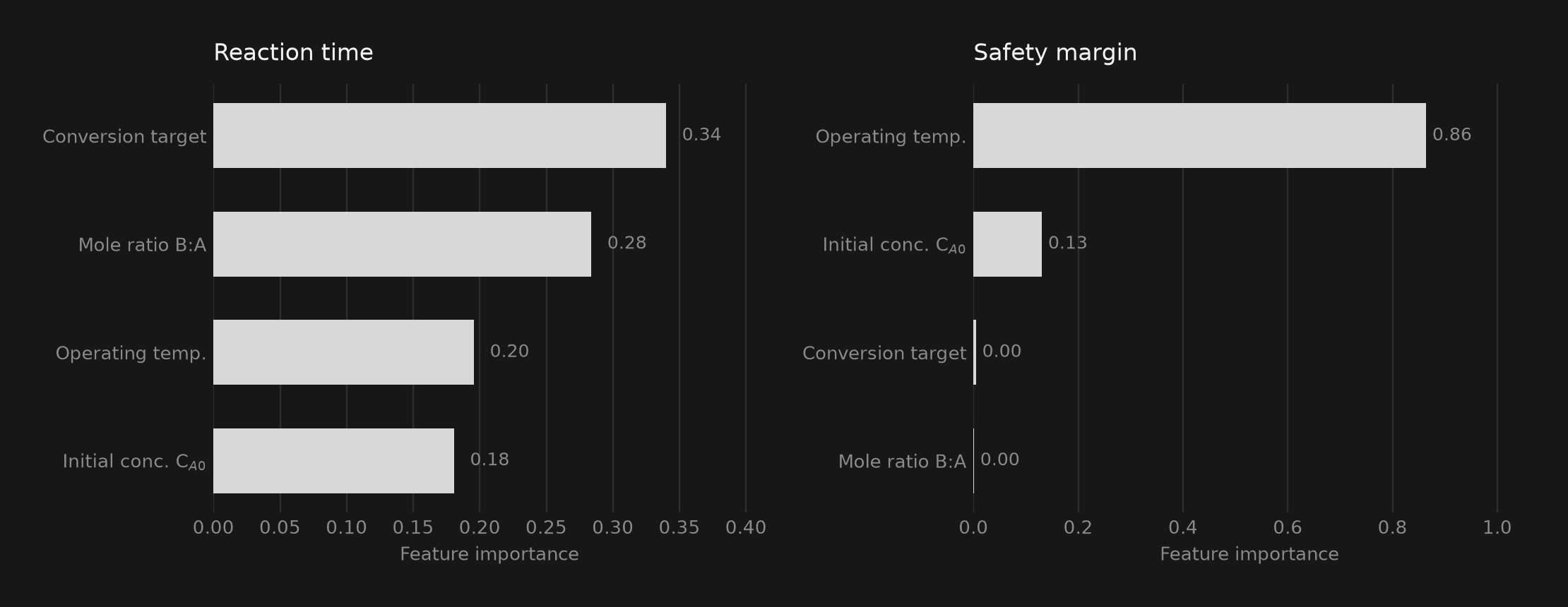
As a side exploration, trained ML surrogates (linear regression and random forest) on 2,000 sampled runs of the physics model to predict reaction time and safety margin directly, without an iterative kinetics solve.
Fig. Reactor sizing, kinetics sensitivity, and the single-shot vs. semi-batch MTSR comparison.
Fig. Feature importance, ML surrogate (random forest) trained on 2,000 physics-model samples.
Kinetic parameters (k, Eₐ) are literature-informed placeholders pending primary-source verification, flagged explicitly since every downstream number (reaction time, MTSR, dosing rate) shifts once verified values are substituted.